Magnet Coatings Explained: Ni-Cu-Ni, Zinc, Epoxy, or Teflon?

介绍

For engineering and procurement teams, selecting the right Neodymium (NdFeB) magnet often revolves around grade, pull force, and maximum operating temperature. However, one of the most critical decisions is frequently treated as an afterthought: the surface coating.

Raw NdFeB contains a high percentage of iron, making it highly susceptible to rapid oxidation and corrosion. Once a magnet begins to rust, it experiences volume expansion, structural crumbling, and a catastrophic loss of magnetic strength.

Choosing a coating is not just about aesthetics or basic rust prevention. As an integrated magnetic component supplier based in Ningbo, the global hub of magnetic manufacturing, Nexal approaches coatings from a strict engineering perspective. A coating fundamentally alters a magnet’s mechanical dimensions, its assembly handling, and its operational air gap.

Here is a factory-direct breakdown of the four most common magnet coatings, going beyond basic definitions to share unique insights on how to choose the right one for your industrial application.

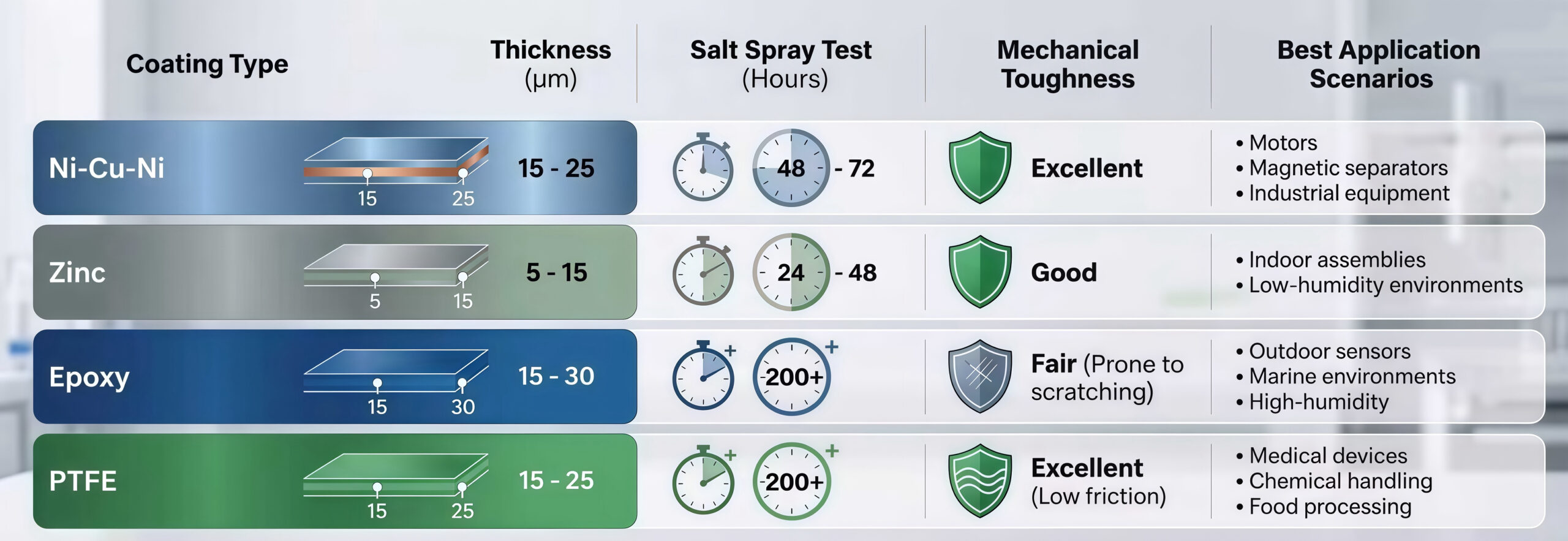
The Industrial Coating Comparison Matrix

1. Ni-Cu-Ni (Nickel-Copper-Nickel): The Industrial Workhorse

This triple-layer electroplating is the industry standard for a reason. It provides a bright, silver finish that resists standard atmospheric moisture effectively.

  • The Factory Insight: Many buyers assume the nickel is doing all the heavy lifting. In reality, the middle Copper (Cu) layer is the unsung hero. Neodymium is notoriously brittle. The copper layer acts as a microscopic shock absorber, adding crucial ductility to the magnet’s surface. When you are assembling hundreds of D24x25mm magnets into stainless steel tubes for a magnetic separator, this copper layer drastically reduces the risk of edge-chipping caused by accidental impacts or strong magnetic snapping.

  • The Verdict: If you are building standard industrial motors, generators, or automated equipment components, Ni-Cu-Ni offers the best balance of cost, durability, and assembly toughness.

2. Zinc (Zn): The Cost-Effective Baseline

Zinc plating is a thin, economical coating that acts as a sacrificial anode, oxidizing before the underlying magnet does. It usually has a duller, bluish-white appearance compared to Nickel.

  • The Factory Insight: Zinc is fantastic for cost reduction in high-volume, fully sealed applications where moisture is completely absent. However, engineers must be cautious about galvanic corrosion. If a Zinc-plated magnet is mounted directly against certain other metals in a humid environment, it can accelerate the corrosion process. Furthermore, because Zinc plating is thinner (often under 10μm), it offers less physical protection against scratching during manual assembly.

  • The Verdict: Choose Zinc strictly for indoor applications, enclosed consumer electronics, or tightly sealed motor housings where ambient humidity is controlled.

3. Epoxy (Black or Grey): The Ultimate Moisture Barrier

Epoxy is a polymer coating applied over a base layer (usually Nickel) to provide phenomenal resistance to salt water, mild acids, and extreme humidity.

  • The Factory Insight: While Epoxy is the absolute champion of the Salt Spray Test (often exceeding 200 hours), it introduces a significant mechanical trap for design engineers: Thickness and Friction. Epoxy is thicker than metallic plating and has a higher coefficient of friction. If you design a precision rotor assembly with a strict ±0.05mm tolerance and specify an Epoxy coating without communicating this to your source factory, the finished magnets will likely be too thick to fit into your stator slots. At Nexal, when a client requests Epoxy, we specifically calculate the coating thickness backwards to reduce the bare magnet’s machining dimensions before coating.

  • The Verdict: Essential for outdoor UAV motors, marine applications, wind turbines, and any sensor exposed to harsh weather. Just ensure your mechanical drawings account for the extra coating volume.

4. Teflon (PTFE): The Niche Problem Solver

Teflon provides excellent corrosion resistance similar to Epoxy but adds the unique properties of being non-stick, non-reactive, and possessing an extremely low coefficient of friction.

  • The Factory Insight: Teflon is highly specialized and significantly more expensive. Its true value lies in its chemical inertness. For clients in the fine chemical or pharmaceutical sectors where a magnetic filter rod might be exposed to aggressive solvents, Teflon is sometimes the only viable option. Additionally, its “slippery” nature makes it ideal for specialized moving components where magnets rub against other surfaces.

  • The Verdict: Reserve Teflon for medical devices, food-grade applications, or highly corrosive chemical handling where standard plating will fail.

The Hidden Rule: Coating Dictates Tolerance

The most common mistake in global magnet sourcing is treating the coating as “just paint.”

When you order a magnet with a strict ±0.05mm tolerance, the factory must grind the raw block to an even tighter tolerance (e.g., ±0.02mm) to leave mathematical room for the 20μm Ni-Cu-Ni plating. If you work with a middleman who simply buys raw magnets and sends them to a third-party plater, you lose complete control over the final dimensions, leading to jammed assemblies and scrapped components.

To secure a reliable supply chain, always partner with an integrated source factory that aligns machining precision and electroplating under one unified quality control system. By matching the right coating to your exact assembly tolerances, you eliminate hidden production costs and guarantee the long-term field reliability of your products.

联系我们

联系方式