
GBD技术:NEXAL 如何在不产生高昂稀土成本的情况下实现机器人关节电机的高矫顽力
快速摘要
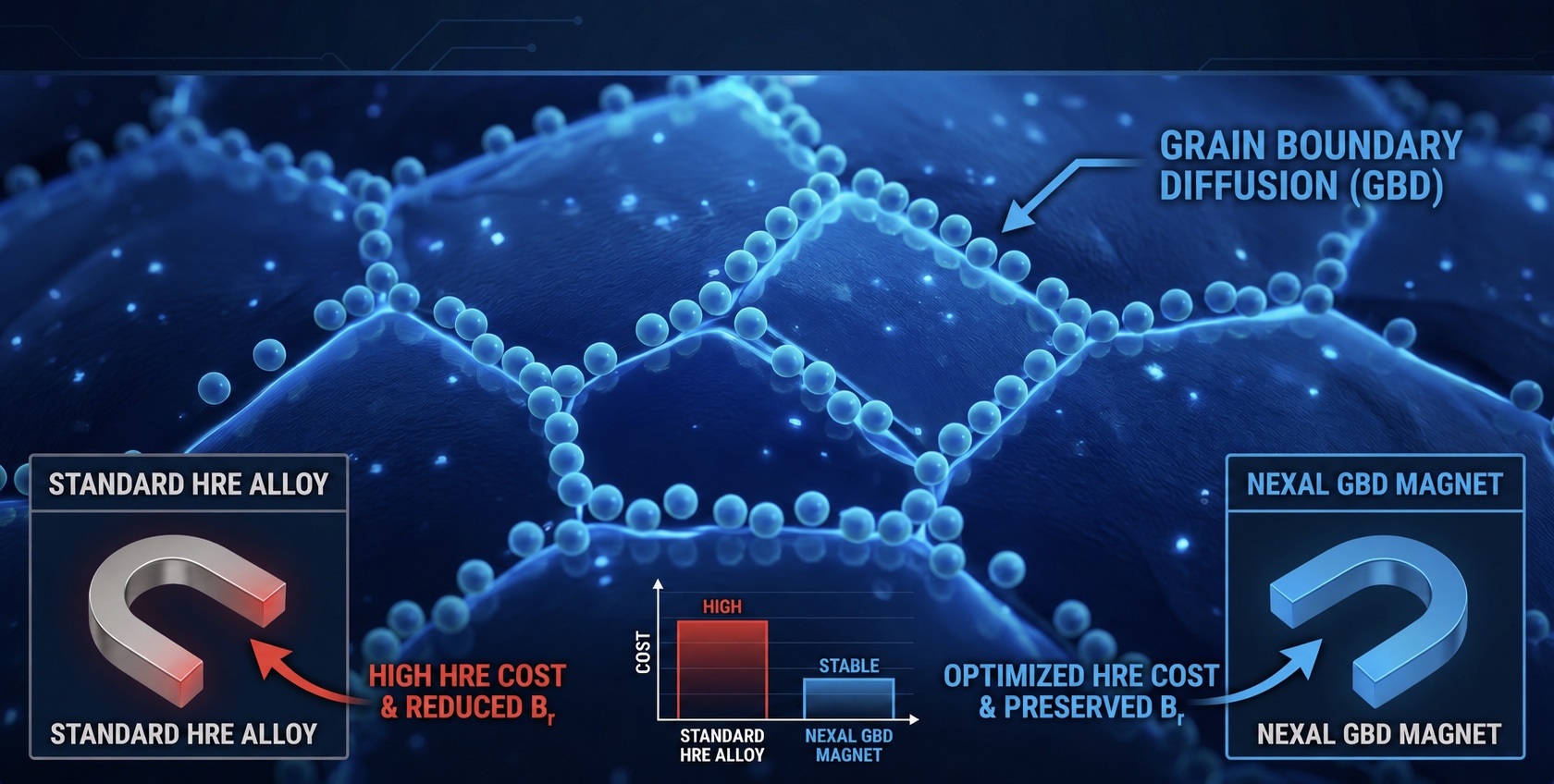
晶界扩散 is a processing method used to increase the intrinsic coercivity (Hcj) of sintered NdFeB magnets while limiting the loss of remanence (Br).
Instead of distributing large amounts of dysprosium (Dy) or terbium (Tb) throughout the entire magnet, GBD introduces these elements mainly through grain-boundary regions near the magnet surface.
GBD can improve resistance to irreversible demagnetization, but its suitability depends on the required coercivity, operating temperature, reverse magnetic field, magnet geometry and cost target.
1. 机器人关节的两难:强制性 vs. 残余磁性
机器人执行器和协作机器人关节在极高的浪涌电流下运行,这要求磁体具有出色的固有矫顽力(Hcj以防止反向场退磁。.
传统上,只能将镝 (Dy) 添加到整个化学熔体中。然而,这种旧方法会引发两个主要问题:
剩磁 (Br) 丢弃 在全球范围内对HRE进行合金化会降低残余磁通密度,这意味着电机的转矩密度会降低。.
成本陷阱 重稀土是波动性商品垄断。对于中小型机器人创业公司来说,标准的重稀土磁铁使得规模化生产成本过高。.
2. GBD 机制:精确分层
与其将昂贵的镝/铽浪费在磁铁核心中,对抵抗外部反向磁场毫无作用,Nexal 利用 晶界扩散.
我们在烧结磁体表面涂覆一层微量的重稀土,并通过精确的热处理工艺,使原子严格沿着NdFeB晶粒的晶界线扩散。.
[标准合金磁铁:镝金属浪费在核心] ➔ 低剩磁,极高价格 ❌ [Nexal GBD 磁铁:镝金属集中在外围] ➔ 高剩磁,优化成本 3. 数据对比:标准版与GBD性能
| 材料特性 | 剩磁 (Br) | 矫顽力 (Hcj) | 重稀土消耗 | 中小企业成本影响 |
| 传统 42UH | 1.28 – 1.33 兆泰拉 | ≥21 kOe | 100% 体相合金化 | 高且易变 |
| Nexal 42SH + GBD | 1.32 – 1.37 T | ≥25 kOe | Can reduce HRE use, depending on grade, geometry and process conditions | 可预测且稳定 |
4. Why Choose Nexal for Your GBD Magnet Project?
GBD magnet selection requires more than choosing a high-coercivity grade. The right solution depends on the required Br and Hcj, magnet geometry, operating temperature, reverse-field conditions, coating and production volume.
Nexal helps customers evaluate these requirements before selecting a material route. We can compare conventional high-coercivity grades with GBD-based options and coordinate suitable manufacturing resources for prototype and production projects.
This application-focused approach helps avoid unnecessary over-specification while balancing magnetic performance, demagnetization resistance, manufacturability and cost.
正在设计下一代协作机器人关节或人形机器人执行器? 不要让材料成本拖慢你的原型开发。.
Contact Nexal to discuss your target grade, magnet dimensions, maximum operating temperature, coating requirements and production quantity.