Products

Common NdFeB Magnet Shapes Used in Electric Motors
In high-performance motor design, geometry is performance. The choice of magnet shape dictates more than just physical fit; it defines Flux Linkage, Torque Ripple, and Thermal Dissipation efficiency.
We don’t just supply magnets; we provide Geometric Engineering to optimize your motor’s electromagnetic signature.
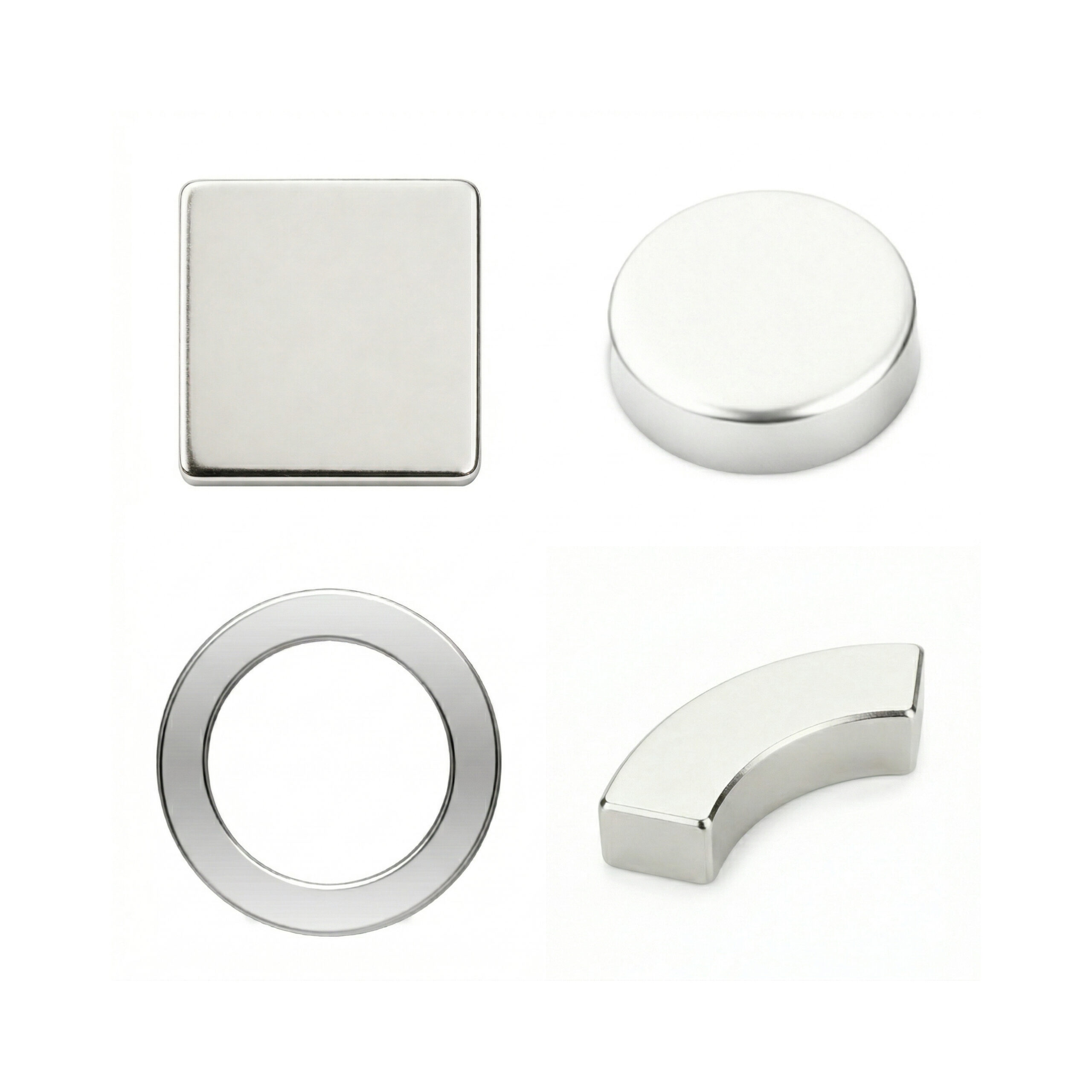
Detailed NdFeB Magnet Shape Matrix
| Magnet Shape | Common Application | Magnetization Best Practice | Engineering Edge |
| Arc (Segment) | High-End BLDC / Servo | Radial / Skewed | Minimizes air gap; maximizes surface flux (Bg). |
| Ring | Precision Micro-Motors | Multi-Pole Radial | Perfect rotational balance; zero-assembly error. |
| Block | IPM / Industrial Drives | Thickness (Axial) | High reluctance torque; buried protection. |
| Disk | Axial Flux / Sensors | Axial / Diametric | Highest torque-to-weight for “Pancake” designs. |
| Cylinder | Haptics / Actuators | Diametric | Ultra-high speed stability in micro-diameters. |
| Custom | High-Acoustic Servo | Sinusoidal Flux Shaping | Drastic reduction in vibration (NVH). |
Shape Deep Dive
1. Arc (Segment) Magnets: The SPM King
Arc magnets are the gold standard for Surface Permanent Magnet (SPM) motors. Their curvature is engineered to match the rotor’s outer diameter perfectly.
- Engineering Insight: Simply matching the radius isn’t enough. By implementing “Skewed” Arc Magnets, designers can break the alignment between stator teeth and rotor poles. This reduces Cogging Torque by up to 80%, achieving aerospace-grade rotational smoothness.
2. Ring Magnets: Mechanical Integrity at Extreme RPM
For ultra-high-speed applications (>50,000 RPM), ring magnets provide a decisive advantage through their monolithic structure.
- Engineering Insight: Unlike segmented magnets that risk detachment due to centrifugal force, Solid Radial Ringsoffer inherent physical integrity. Furthermore, radial orientation allows for extreme magnetic uniformity, making them indispensable for high-precision encoders and drone propulsion.
3. Block Magnets: The Foundation of Reluctance Torque
While block magnets appear simple, they are the functional heart of Interior Permanent Magnet (IPM) motors.
Engineering Insight: By “burying” block magnets into rotor laminations, engineers create a Salient Pole structure that generates Reluctance Torque. This not only protects the magnets from demagnetizing flux but also allows for high-torque performance using lower-grade (cost-effective) materials.
4. Disk Magnets: Powering the Axial Flux Revolution
With the rise of Collaborative Robots (Cobots), disk magnets have become vital for “Pancake” or Axial Flux motors.
Engineering Insight: Disk magnets allow flux to travel axially rather than radially. This orientation enables an incredibly high Torque-to-Weight Ratio. If your design requires a razor-thin motor profile without sacrificing torque, an array of axially magnetized disks is the only solution.
5. Cylinder Magnets: Micro-Precision & Actuation
Cylindrical magnets are found in micro-motors (e.g., haptic feedback) and high-accuracy sensors.
Engineering Insight: In sensor applications, Diametrically Magnetized cylinders provide a field that varies perfectly linearly with the angle of rotation. This is critical for non-contact potentiometers where field consistency directly determines sensor resolution.
6. Custom Shapes: The Secret to Sinusoidal Flux
Shapes like “Bread-loaf,” Trapezoidal, or Wedged magnets represent the peak of electromagnetic refinement.
Engineering Insight: The goal here is “Flux Shaping.” By designing a magnet that is thicker at the center and tapered at the edges (Bread-loaf), the resulting magnetic field more closely resembles a Sine Wave. This significantly lowers electromagnetic noise (NVH), a core requirement for luxury automotive auxiliary motors and silent home appliances.
Shaping Your Performance
The choice of shape should not be determined by assembly space alone, but by your requirements for the Magnetic Waveform.
Need Maximum Compactness? Choose Disk (Axial Flux).
Need Silent Operation? Choose Custom (Bread-loaf).
Need Mass-Scale Economy? Choose Block (IPM).
The Critical Role of Magnetization Direction
Shape alone is not enough; the Magnetization Direction must align with the rotor’s flux path.
Radial Magnetization: Flux travels from the center outward. Essential for high-efficiency ring magnets.
Diametric Magnetization: Flux travels across the diameter. Common in simple 2-pole sensors or small DC motors.
Axial Magnetization: Flux travels along the thickness. Typical for disc motors or magnetic couplings.
FAQ
Q: Why are custom shapes like “Bread-loaf” more expensive?
A: They require precision profile grinding rather than simple slicing. The increased machining time and the need for strict magnetic orientation alignment drive the premium.
Q: Can a single ring magnet support multiple poles?
A: Yes. We can magnetize a single ring with 4, 8, 12, or more poles. This eliminates the manual error of gluing segments and is the best method for improving high-speed dynamic balance.
Q: How do I determine the best shape during the R&D phase?
A: We recommend Finite Element Analysis (FEA) to simulate how different geometries affect your air gap flux. Our engineering team can assist you in optimizing these geometries before tooling begins.