Products

The Real Cost of Neodymium Magnets: What Determines Your Final Price?
Introduction
For procurement directors and engineering managers sourcing Neodymium (NdFeB) magnets, receiving a wide range of price quotes for seemingly identical specifications can be incredibly frustrating. Why does one supplier quote $0.15 per piece while another quotes $0.25?
The truth is, industrial Neodymium magnets are not standard commodities; they are highly engineered components. The final price on your Proforma Invoice is dictated by a complex matrix of raw material markets, machining difficulty, precision requirements, and supply chain layers.
If you want to optimize your procurement budget without sacrificing performance, you need to understand exactly what you are paying for. Here is a transparent breakdown of the real cost drivers behind NdFeB magnets.
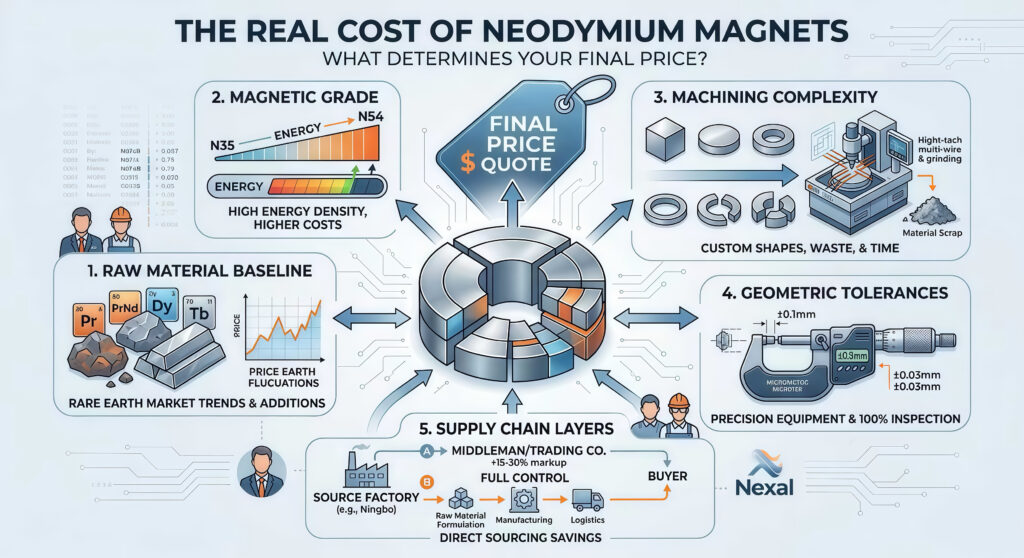
1. Raw Material Fluctuations: The Rare Earth Baseline
The absolute foundation of a magnet’s cost is the raw material market. NdFeB magnets are primarily composed of Praseodymium-Neodymium (PrNd) metal, Iron, and Boron.
The PrNd Market: Rare earth metal prices are traded on the open market and fluctuate based on mining quotas, environmental regulations, and global demand. When PrNd prices spike, magnet prices inevitably follow.
Heavy Rare Earth Additions (Dy & Tb): If your application requires high-temperature stability (e.g., N50SH for electric motors operating at 150°C), manufacturers must introduce heavy rare earth elements like Dysprosium (Dy) or Terbium (Tb) through Grain Boundary Diffusion (GBD) technology. These elements are significantly rarer and more expensive than PrNd, which is why high-temperature grades carry a distinct premium over standard grades.
2. Magnetic Grade: You Pay for Magnetic Density
The grade of the magnet (from N35 to N54) directly correlates to its energy product and manufacturing cost.
Higher grades like N52 or N54 require a higher concentration of pure rare earth materials and stricter atmospheric controls during the sintering process to achieve maximum remanence (Br). While N52 offers unparalleled magnetic strength, it is also highly brittle and expensive. For many industrial applications, such as magnetic separators or sensor triggers, a well-engineered N40 or N45 magnet—optimized with the right magnetic circuit—can achieve the required surface Gauss at a fraction of the N52 cost.
3. Machining Complexity: Multi-Wire Cutting and Custom Shapes
Neodymium magnets are extremely hard and brittle ceramic materials. They cannot be poured into a mold; they must be sliced, ground, and drilled from large sintered blocks using diamond tools.
Standard vs. Custom Shapes: Standard shapes like simple blocks or small discs are highly cost-effective because they can be produced using high-volume slicing machines. Conversely, complex geometries, thin-walled rings, or segments requiring precision multi-wire cutting consume significantly more machining time and generate more raw material waste.
The Scrap Rate Factor: You are not just paying for the final magnet; you are paying for the material lost as dust during the cutting process.
4. Geometric Tolerances: The Hidden Cost of Precision
Tolerance is the most overlooked cost driver in B2B magnet procurement. The industry standard tolerance is typically ±0.1mm. If your engineering drawings demand a strict limit of ±0.05mm or even ±0.03mm to ensure a flawless press-fit into a motor rotor or a stainless steel tube, the cost will increase.
Why? Achieving extreme tolerances requires advanced centerless grinding equipment, slower processing speeds, and meticulous 100% automated inspection lines. Furthermore, tightening the tolerance inherently increases the factory’s internal scrap rate. However, investing in tight-tolerance components from the source factory often saves integrators thousands of dollars down the line by eliminating assembly friction and product failures.
5. Supply Chain Layers: Trading Companies vs. Source Factories
Finally, who you buy from impacts your price just as much as what you buy. Many overseas buyers unknowingly purchase from local trading companies or middlemen rather than direct manufacturers. Middlemen must add a 15% to 30% markup to cover their own overhead.
By bypassing intermediaries and sourcing directly from a comprehensive manufacturing hub—such as Ningbo, the global capital of magnetic materials—buyers unlock true factory-direct pricing. A true source factory like Nexal controls the entire lifecycle, from raw material formulation to final electroplating and international logistics. This direct-to-manufacturer relationship ensures transparent pricing, faster communication for engineering adjustments, and scalable support from a 2,000-piece pilot run to a 200,000-piece mass production order.
Conclusion: Sourcing Smarter, Not Just Cheaper
The cheapest quote is rarely the most cost-effective solution in the long run. The real cost of a Neodymium magnet includes its reliability, its dimensional consistency, and its resistance to demagnetization in the field. By understanding how raw materials, tolerances, and supply chain choices affect your final price, you can engineer unnecessary costs out of your products and build a more resilient, profitable manufacturing line.