Products

Beyond the Golden Sample: How to Guarantee Magnetic Consistency from 100 Prototypes to 100,000 Mass Production Units
Introduction
Every experienced supply chain manager in the industrial sector knows the dread of the “Golden Sample.”
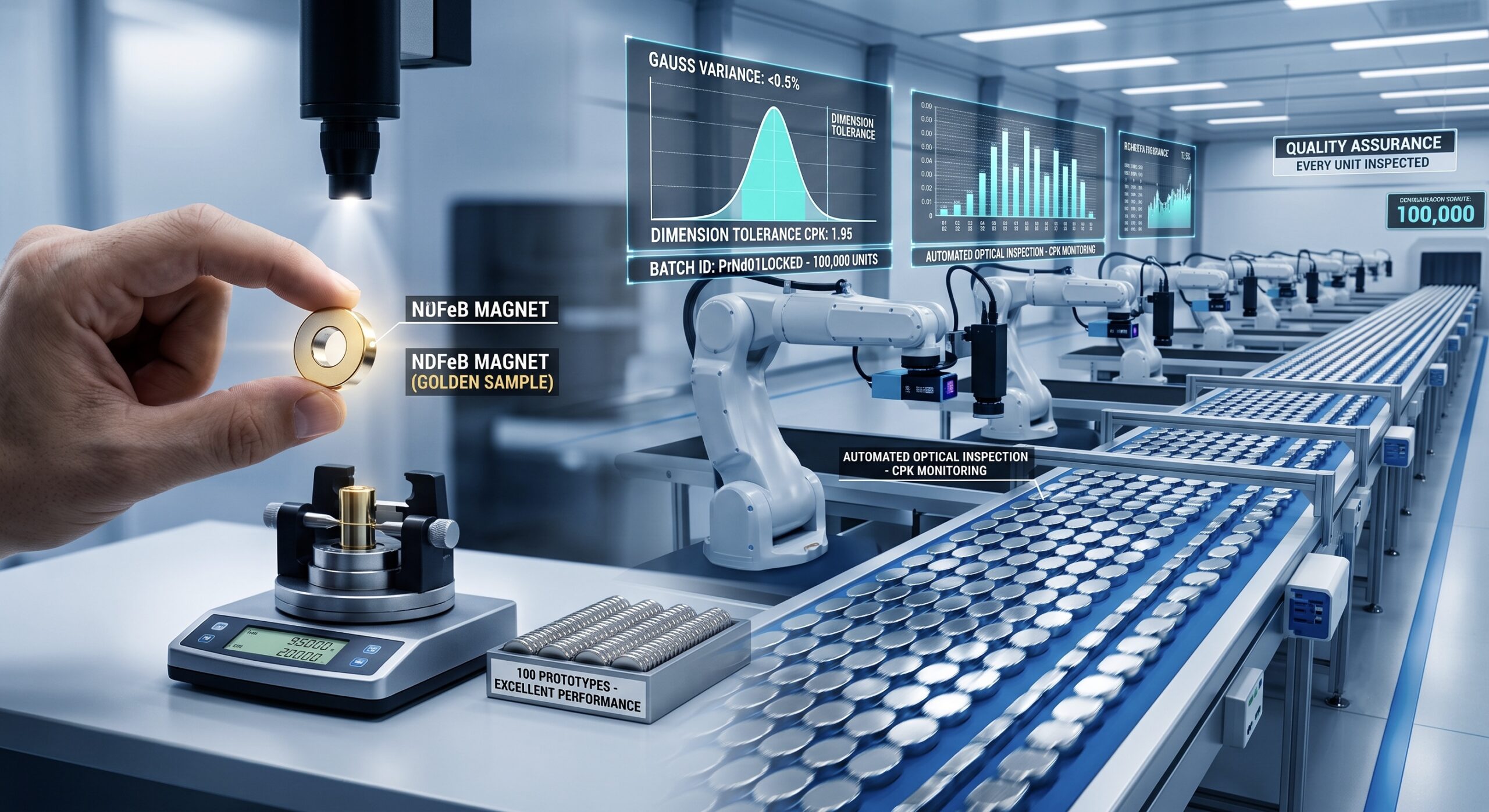
During the pilot phase, a supplier delivers 100 flawless Neodymium (NdFeB) prototypes. The magnetic flux density is perfect, the dimensions are exact, and the coating is pristine. You sign off on the design and place an order for 100,000 units. But when the mass production batch arrives, the reality sets in: surface Gauss values fluctuate wildly, dimensional tolerances drift, and assembly lines grind to a halt because the magnets no longer fit into the designated stators or stainless steel housings.
This bait-and-switch—whether intentional or the result of poor process control—is the hidden killer of global procurement. At Nexal, we believe that true manufacturing excellence is not proven by making one perfect magnet; it is proven by making 100,000 identical ones.
Here is the hardcore engineering reality of how a reliable source manufacturer guarantees absolute magnetic and dimensional consistency as your project scales from a pilot run to mass commercialization.
1. Locking the Metallurgical Formula: The Chemistry of Consistency
Generic suppliers often source raw sintered blocks from various sub-contractors based on daily spot prices. This means your pilot sample might be made from one batch of Praseodymium-Neodymium (PrNd) metal, while your mass production order is cut from a completely different metallurgical batch. This invariably leads to erratic Remanence (Br) and Intrinsic Coercivity (Hcj).
Consistency must be locked in at the chemical level. For specialized industrial projects—such as heavy-duty transformers or robotics actuators requiring extreme thermal stability—the raw material formulation cannot be left to chance.
By leveraging advanced Grain Boundary Diffusion (GBD) technology, trace amounts of heavy rare earths (like Dysprosium or Terbium) can be precisely penetrated into the magnet’s grain boundaries. This allows the factory to dramatically boost the heat resistance (coercivity) of the mass production batch without relying on inconsistent, heavily doped raw blocks. A strict traceability system ensures that the chemical signature of the 100,000th piece perfectly matches the 1st piece.
2. Process Capability Index (CPK) over Final Inspection
Many trading companies boast about their “strict QC.” But if a factory relies solely on sorting out bad parts at the end of the line, you are already paying for their high scrap rate.
Consistency is engineered, not inspected. Take the standard D24x25mm magnetic cylinders used in industrial separator rods as an example. If the machining tolerance is a loose ±0.1mm, stacking these magnets will result in severe cumulative errors, causing internal air gaps and a catastrophic drop in surface Gauss.
To guarantee consistency, the factory floor must operate with a high Process Capability Index (CPK). By utilizing automated centerless grinding machinery, the geometric tolerances can be strictly locked within a ±0.05mm or even ±0.02mm window. When the mechanical dimensions are this tightly controlled at the machining stage, the flux density projected outward remains mathematically predictable and uniformly stable across the entire production run.
3. Agile Scalability: The Source Factory Advantage
A common dilemma for hardware startups and specialized equipment manufacturers is finding a partner who can handle both small custom batches and massive commercial rollouts. Large, rigid factories often reject pilot orders, while small workshops lack the automated infrastructure to scale quality.
This is where manufacturing heritage and strategic facility deployment become a critical advantage. With 18 years of deep-rooted manufacturing expertise in Ningbo—the global epicenter of magnetic materials—coupled with advanced operational capabilities extending into high-tech robotics industrial parks in Wuxi, a highly flexible supply chain is born.
Whether you are negotiating a 2,000-piece pilot order for a new overseas separation facility, or ramping up to a fully standardized mass supply contract, the production protocols remain identical. The engineering team that calibrated your prototypes oversees the automated lines producing your mass volume.
Conclusion: Audit the Process, Not Just the Sample
The next time you evaluate a magnet supplier for a critical industrial or robotics application, look past the Golden Sample. Ask them about their PrNd batch tracking, their centerless grinding CPK, and their in-house GBD capabilities.
Procurement security comes from partnering with a source manufacturer that treats consistency as a mathematical certainty, not a lucky outcome. By demanding rigorous process control from prototype to mass production, you eliminate assembly line bottlenecks, protect your profit margins, and secure the long-term field reliability of your products.