Products

Stop Overpaying for Neodymium Magnets: A Sourcing Guide to “Right-Sizing” Your Specs
Introduction
For Small and Medium-sized Enterprises (SMEs) and hardware startups, protecting profit margins is critical. Yet, when it comes to sourcing Neodymium (NdFeB) magnets, many procurement teams and junior engineers unknowingly bleed their budgets by falling into the “over-specification trap.”
Without deep expertise in magnetics, it is common to default to the “safest” option on paper: specifying the absolute highest grade (like N52), demanding extreme heat resistance, or drawing up ultra-tight geometric tolerances.
While this might guarantee performance, it also guarantees you are paying a massive, unnecessary premium. At Nexal, our engineering team frequently audits client blueprints and finds opportunities to slash costs by 15% to 30% without sacrificing a single drop of operational performance.
Here is how smart buyers “right-size” their magnet specs to stop overpaying.
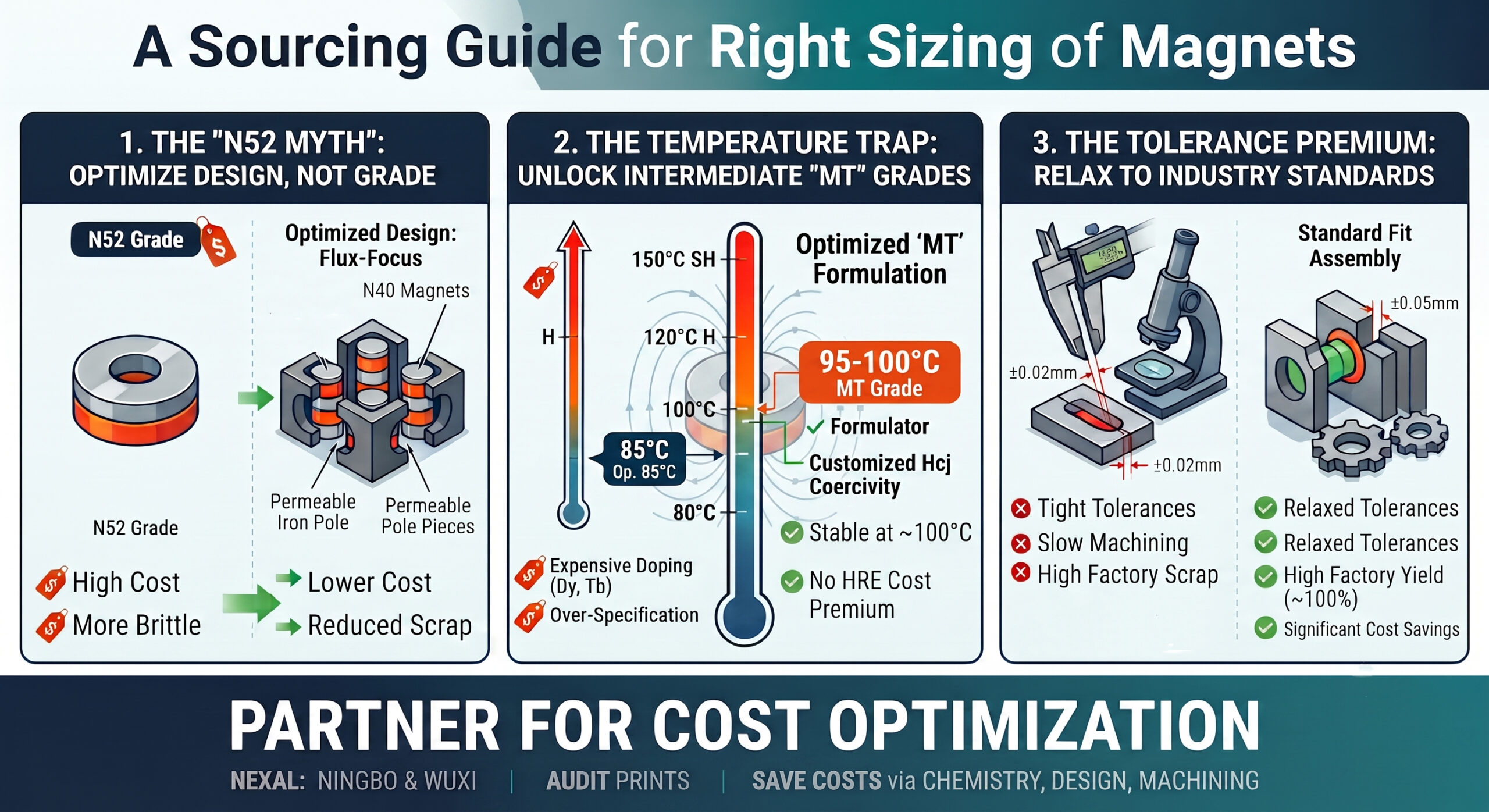
1. The "N52 Myth": Why Maximum Grade Isn't Always Maximum Value
When engineers need a strong magnetic pull force, the instinct is to immediately spec N52—the highest standard commercial grade.
However, jumping from an N45 to an N52 significantly increases the raw material cost because it requires higher purity PrNd (Praseodymium-Neodymium) metal. Furthermore, N52 is more brittle, increasing the machining scrap rate.
The Right-Sizing Solution: Performance is rarely just about the raw block of magnet; it is about the Magnetic Circuit Design. By strategically arranging N40 or N45 magnets with highly permeable iron pole pieces (a flux-concentrating design), you can forcibly direct the magnetic field to achieve the exact same surface Gauss as a standalone N52 magnet. You get the same physical performance for your motor or sensor, but at a fraction of the raw material cost.
2. The Temperature Trap: Unlocking Intermediate "MT" Grades
Heat is the enemy of Neodymium magnets. To prevent demagnetization, buyers often over-spec their temperature requirements. If a device operates at 85°C, an engineer might nervously order an “H” grade (rated for 120°C) or even an “SH” grade (rated for 150°C) just to be safe.
This safety net is incredibly expensive. High-temperature grades require the addition of Heavy Rare Earth elements like Dysprosium (Dy) or Terbium (Tb), which are significantly costlier than standard rare earths.
The Right-Sizing Solution: You do not have to choose between a basic 80°C magnet and an expensive 120°C “H” grade. A reliable source factory can formulate intermediate grades, such as the “MT” series. These customized intermediate specifications are specifically engineered to bridge the thermal gap. By fine-tuning the intrinsic coercivity (Hcj) to exactly match your real-world operational ceiling (for example, a stable 95°C to 100°C), an MT grade eliminates the need for expensive heavy rare earth doping. You get the thermal stability you actually need, without paying the premium for the heat resistance you don’t.
3. The Tolerance Premium: Loosening Up to Lower Costs
In mechanical engineering, tighter tolerances generally mean better quality. But in magnet manufacturing, requesting a tolerance of ±0.02mm when ±0.05mm would suffice is a costly mistake.
Neodymium is a hard, ceramic-like material. Achieving extreme micro-tolerances requires slower processing speeds on centerless grinding machines and inevitably leads to a higher factory scrap rate. If the supplier throws away 10% of the magnets because they fall outside a microscopic tolerance window, they pass that cost directly onto your invoice.
The Right-Sizing Solution: Analyze your assembly process. If you are potting the magnet in epoxy or inserting it into a housing with a reasonable clearance fit, relax your tolerance to the industry standard of ±0.05mm. The factory yield rate will approach 100%, and a transparent source manufacturer will pass those machining savings directly back to you.
Conclusion: Partner with a Consultant, Not Just a Vendor
True cost optimization in hardware manufacturing doesn’t come from blindly negotiating a few cents off the price of an N52 block. It comes from partnering with a source factory that understands how to manipulate magnetic chemistry, circuit design, and machining limits in your favor.
Operating out of Ningbo and Wuxi, our engineering teams do more than just manufacture prints; we audit them. Before you finalize your next BOM, let us review your specifications. By right-sizing your grades, utilizing intermediate MT formulations, and optimizing your tolerances, we can help you engineer unnecessary costs out of your supply chain.