Products

GBD Technology: How NEXAL Achieves High Coercivity for Robotic Joint Motors Without High Heavy-Rare-Earth Costs
Quick Summary
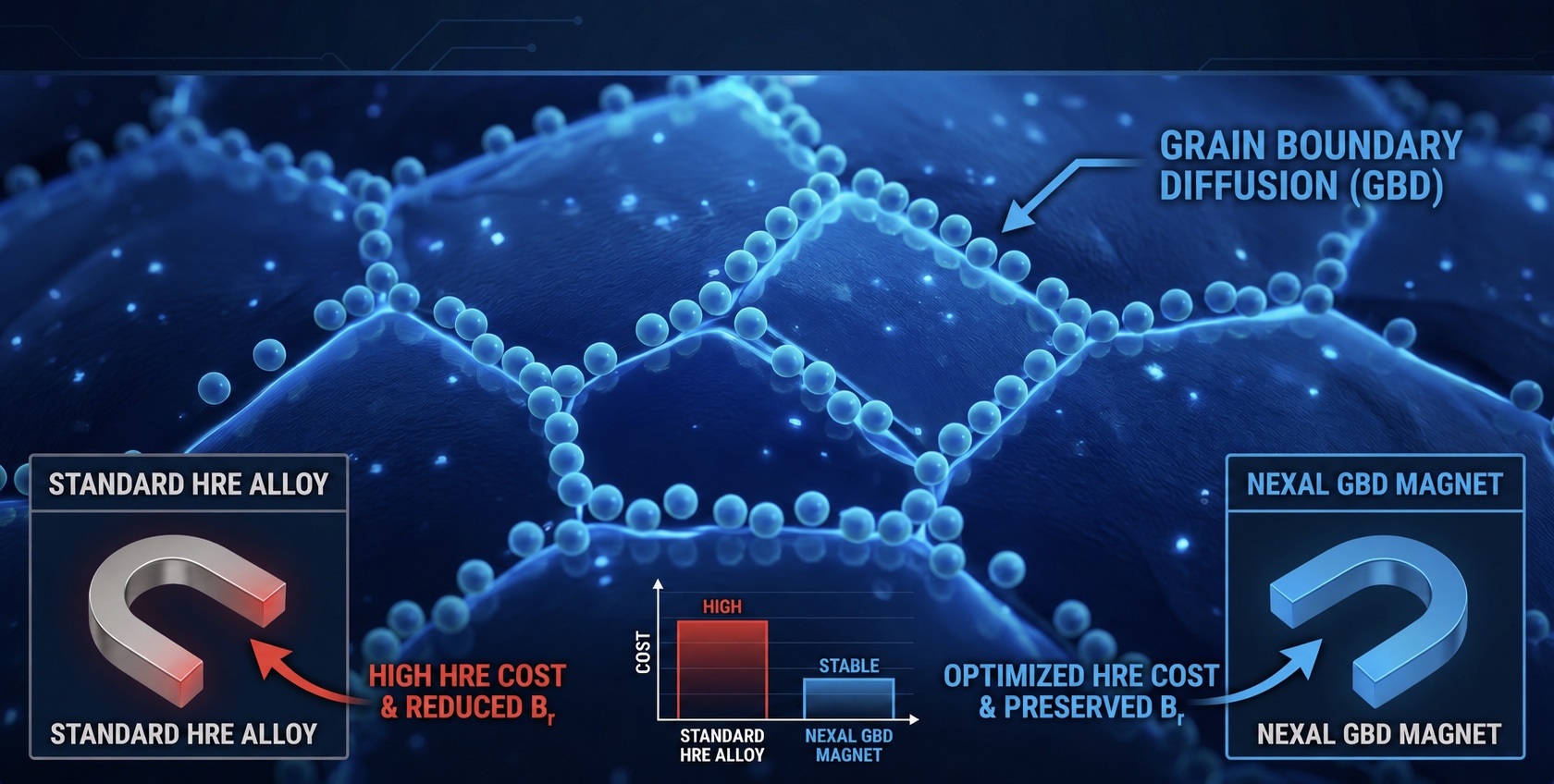
Grain Boundary Diffusion (GBD) is a processing method used to increase the intrinsic coercivity (Hcj) of sintered NdFeB magnets while limiting the loss of remanence (Br).
Instead of distributing large amounts of dysprosium (Dy) or terbium (Tb) throughout the entire magnet, GBD introduces these elements mainly through grain-boundary regions near the magnet surface.
GBD can improve resistance to irreversible demagnetization, but its suitability depends on the required coercivity, operating temperature, reverse magnetic field, magnet geometry and cost target.
1. The Robotic Joint Dilemma: Coercivity vs. Remanence
Robotic actuators and cobot joints operate under extreme current spikes, demanding magnets with exceptional intrinsic coercivity (Hcj) to prevent reverse-field demagnetization.
Traditionally, adding Dysprosium (Dy) to the entire chemical melt was the only option. However, this old method triggers two major issues:
The Remanence (Br) Drop: Alloying HRE globally decreases the residual flux density, meaning your motor loses torque density.
The Cost Trap: Heavy rare earths are volatile commodity monopolies. For SME robotics startups, standard HRE magnets make scaling cost-prohibitive.
2. The GBD Mechanism: Precision Layering
Instead of wasting expensive Dy/Tb in the core of the magnet where it does nothing to combat external reverse fields, Nexal utilizes Grain Boundary Diffusion (GBD).
We apply a micro-coating of heavy rare earths to the sintered magnet surface and use precise thermal processing to diffuse the atoms strictly along the boundary lines of the NdFeB crystal grains.
[Standard Alloy Magnet: Dy Wasted in Core] ➔ Low Br, Extreme Price ❌ [Nexal GBD Magnet: Dy Focused on Boundaries] ➔ High Br, Optimized Cost 3. Data Comparison: Standard vs. GBD Performance
| Material Profile | Remanence (Br) | Coercivity (Hcj) | Heavy Rare Earth (HRE) Consumed | Cost Impact for SME |
| Traditional 42UH | 1.28 – 1.33 T | ≥21 kOe | 100% Volume Alloyed | High & Volatile |
| Nexal 42SH + GBD | 1.32 – 1.37 T | ≥25 kOe | Can reduce HRE use, depending on grade, geometry and process conditions | Predictable & Stable |
4. Why Choose Nexal for Your GBD Magnet Project?
GBD magnet selection requires more than choosing a high-coercivity grade. The right solution depends on the required Br and Hcj, magnet geometry, operating temperature, reverse-field conditions, coating and production volume.
Nexal helps customers evaluate these requirements before selecting a material route. We can compare conventional high-coercivity grades with GBD-based options and coordinate suitable manufacturing resources for prototype and production projects.
This application-focused approach helps avoid unnecessary over-specification while balancing magnetic performance, demagnetization resistance, manufacturability and cost.
Designing a next-gen cobot joint or humanoid actuator? Don’t let material costs stall your prototype.
Contact Nexal to discuss your target grade, magnet dimensions, maximum operating temperature, coating requirements and production quantity.